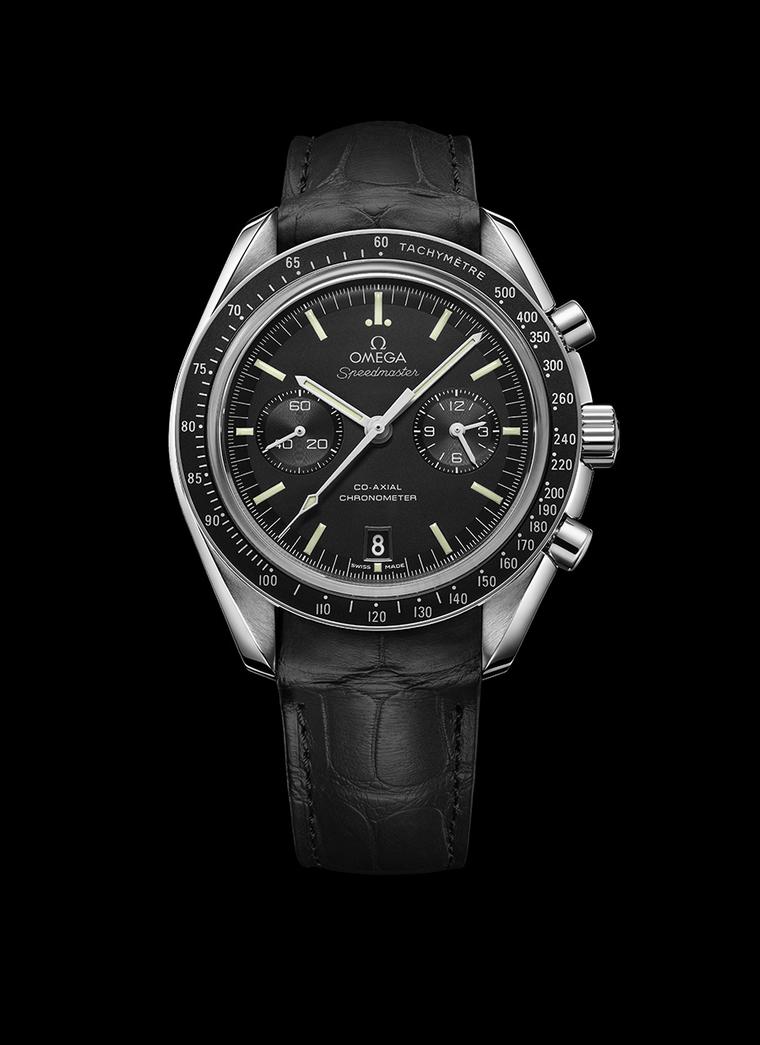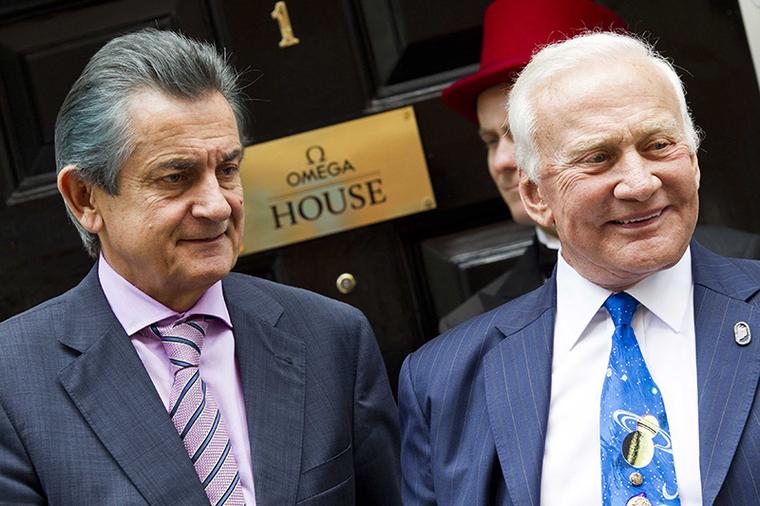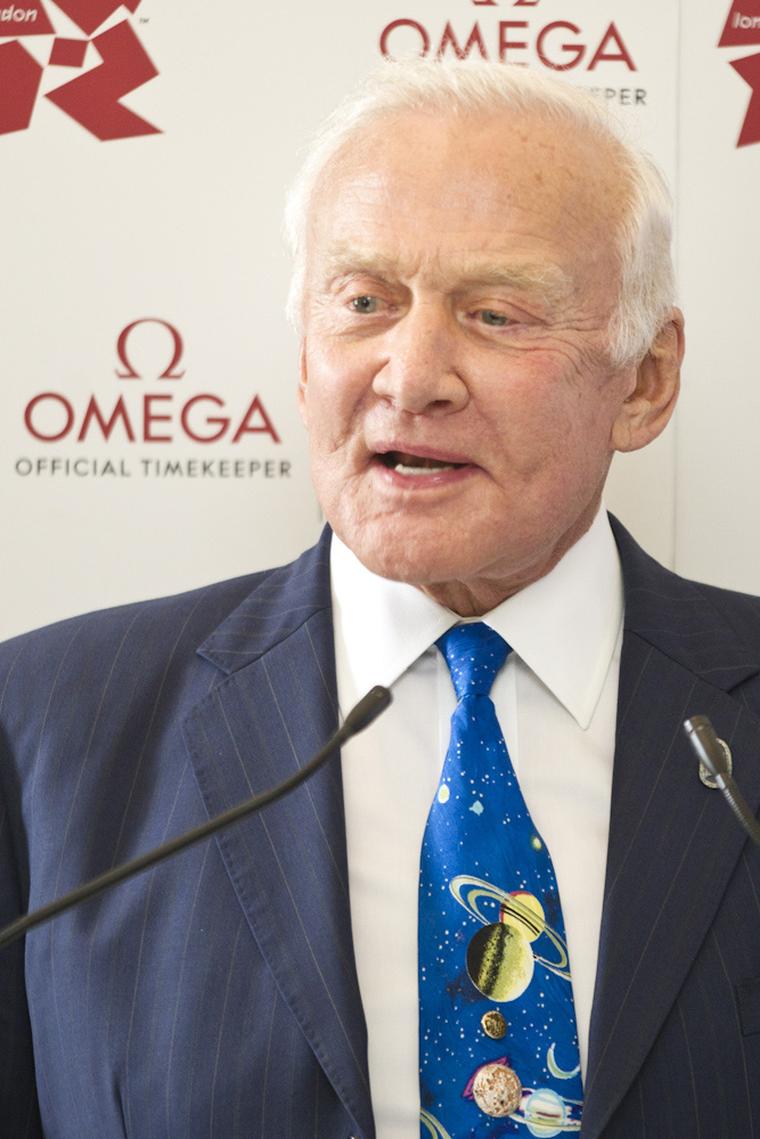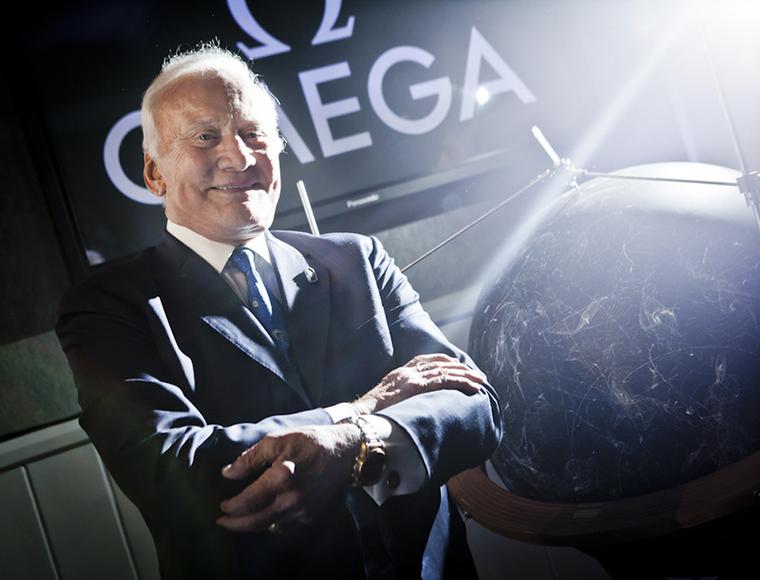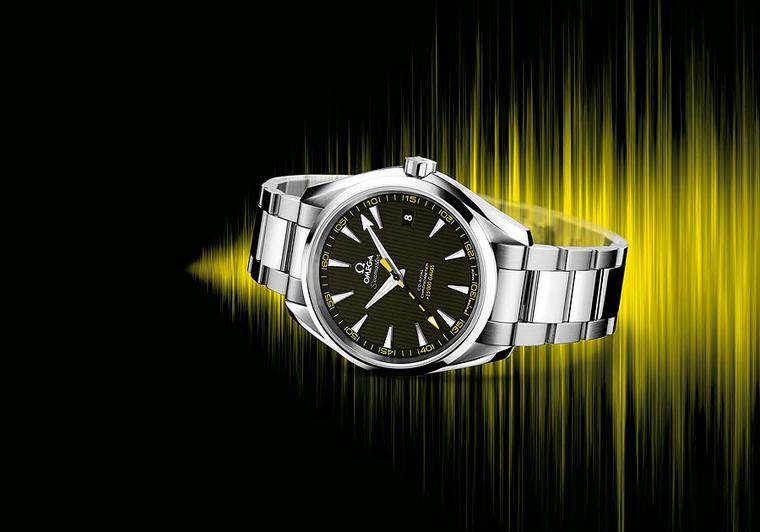
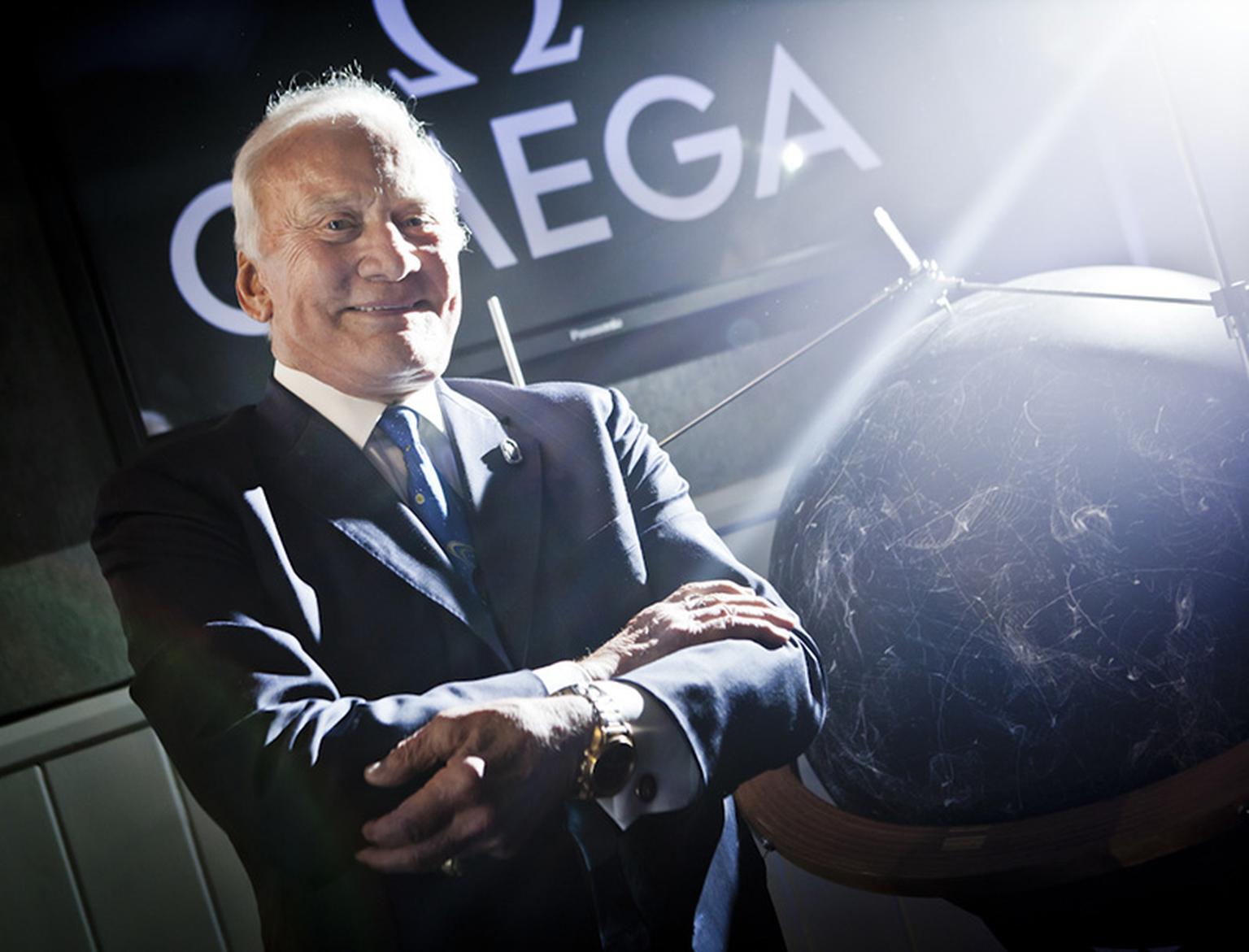
Much anticipation surrounded the arrival of Buzz Aldrin at Omega House in London yesterday as journalists and friends of the watch brand Omega gathered to hear Buzz talk about his lunar travels. The connection between Buzz Aldrin and Omega is the fact that he wore an Omega Speedmaster in Apollo 11 including during his 2 1/2 hour moon walk that made history in 1969.
Dressed in a senatorial blue suit and a colourful tie with planets punctuated by several badges, on his wrist was an interesting looking watch that had not one, but two dials on the metal bracelet. A gold chronograph sat on his wrist, while around the back was another dial I was straining to have a look at.
As well as his watch, I had a particularly good look at those feet that walked on the moon and have to report that they looked smaller in his black suede loafers than they did in his moon boots. Another of his accessories that was space themed was the gold ring on his right hand that looked like a crescent moon with a little star alongside it. His clear blue eyes were steady and the mellow burr of his voice was comforting and confident, reassuring qualities for an astronaut who has seen a darkness we will never know.
Dr. Aldrin opened the talk by remarking that he was the one who wore his watch on the moon, while Neil Armstrong left his in the Eagle lunar module. He went on to talk about the importance of team work and space exploration. Born on Jan 30 1930 in Newark, New Jersey, Dr Aldrin, an MIT scientist and fighter pilot became an ambassador for Omega in 2009. He got his name from his older sister Fay Ann who couldn't pronounce 'brother' when he was born and since then he has changed his name to Buzz by deed poll.
But back to the famous moon watch. According to his biography "Magnificent Desolation" this is how he came to be the one to wear the Omega Speedmaster on his wrist for that historic moment in 1969 and endow the watch with the credit of being the first watch on the moon: "As Omega did with all their astronauts, I was given one of their Speedmaster watches as a Gemini astronaut, which I had worn during my Gemini 12 flight. I also wore an Omega Speedmaster during the Apollo 11 mission. The watch is clearly visible in many of the pictures of me on the Moon, so it could easily be assumed that my timepiece was the most famous wristwatch in the world. It was optional to wear this while we were walking on the surface of the moon. Neil chose not wear his. And few things are less necessary when walking around on the moon than knowing what time it is Houston, Texas. Nonetheless, being a watch guy I decided to strap the Speedmaster onto my right wrist around the outside of my bulky spacesuit."
Unfortunately, Dr Aldrin's Moonwatch, that he handed back to NASA went missing in the early 1970's on way to Smithsonian as all the astronauts gave back their watches. Neil Armstrong was the only other man in the lunar module with him and his Speedmaster is now in National Air Force museum, Washington DC.
How Omega came to be the choice watch of NASA is a credit to the precision and reliability of their chronographs. In 1962 Omega were not aware that NASA had bought ten watches from Corrigan's jewellery store in Houston - one of them was an Omega Speedmaster. The Speedmaster was the winner of the NASA battery of tests deeming it space worthy, and so Omega went to the moon and began a long association with space travel.
NASA still equip their astronauts with wind-up Omega Speedmaster chronographs, because should all the high-tech equipment fail - as it did on Apollo 13 - the watch can be relied on to carry out vital calculations to get back to earth safely as it was designed to calculate speed with the chronograph and tachymeter functions. And the original 1957 Speedmaster has proved time and time again an invaluable and life-saving partner to pilots and astronauts. With an impressive track record of 11 NASA tests and 6 Moon landings, the Speedmaster has been on every US manned space flight and is currently on board Russia's MIR International Space Station making this manual-winding timepiece a cornerstone of horological and space history.
OMEGA's Speedmaster Chronograph was officially "flight-qualified by NASA for all manned space missions" in 1965 although the Speedmaster had already been to space on the wrist of astronaut Walter Schirra on board the Sigma 7 in 1962. Able to withstand extreme temperature changes and zero gravity, when the Speedmaster touched down on the moon with Apollo 11 astronauts in July 1969 it subsequently became known as the Moonwatch.
During the troubled and dramatic Apollo 13 "Houston, we've had a problem here" mission of 1970, the Speedmaster saved the day. The explosion of a reserve oxygen tank compromised all the time keeping mechanisms on board, except one. Commander James Lovell relied on his Speedmaster Chronograph to time, within a fraction of a second, the extremely critical firing of the re-entry rockets allowing for the safe return of his crew to planet Earth. In recognition of the crucial role that its Speedmaster chronograph played on the Apollo 13 mission, OMEGA received the "Snoopy" Award in October 1970 -the highest honour awarded by NASA astronauts. The Speedmaster was present for yet another decisive moment in space history during the 1975 joint USSR-USA Apollo-Soyuz docking. The symbolic handshake in space at the height of the Cold War revealed that both crews were wearing the Speedmaster Chronograph.