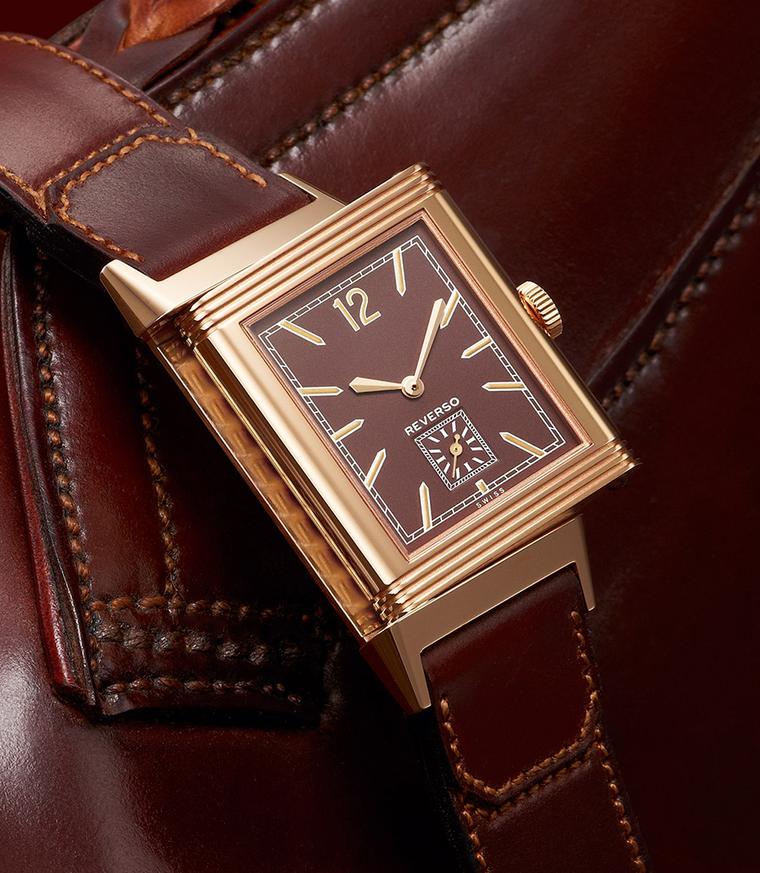
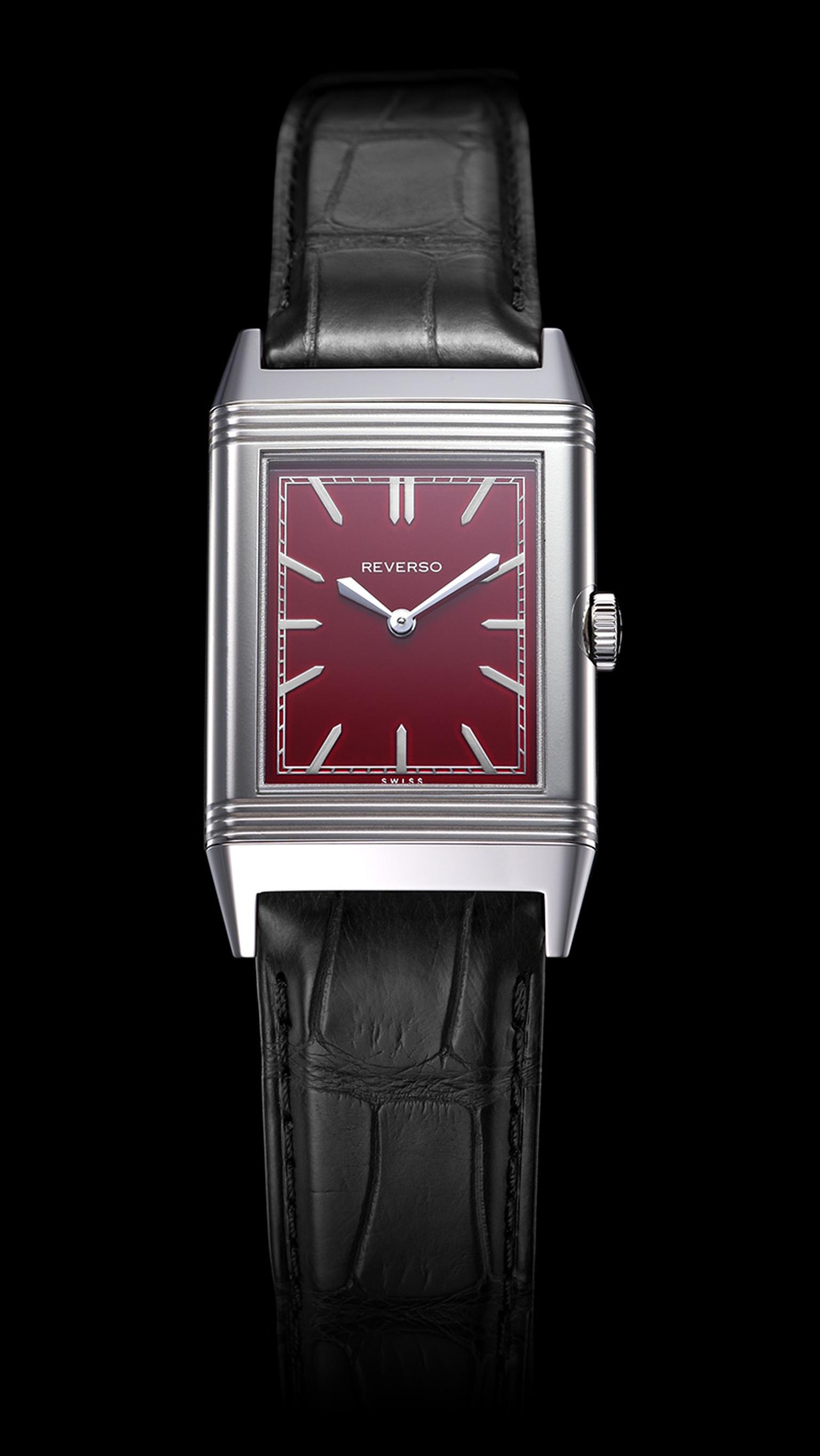
During the "Années Folles" in in France of the 1930's to wear a watch with a blue or a brown dial was considered most daring. From the house's wide colour of dial options, the majority opted for the bon-ton of ivory, white or gold dials. So those who chose to wear a Reverso with a red dial stood out as being highly individual and ever so racy and daring.
Jaeger-LeCoultre, creator of the Reverso, decided to create a new version of this red-face dare-devil of a watch. Available only in Jaeger-LeCoultre boutiques, the large rectangular case holds a handwinding mechanical movement, the Calibre 822.
The Reverso had a good start in life, as like many enduring designs, it was born out of necessity - if polo playing can be considered a necessity. Eighty years on the success of the Reverso proves that function-led design can be the elixir of eternal youth. The story goes that in the early 1930's during the days of British Colonial rule in India and before the invention of resilient crystal officers were finding that their watch glasses were being shattered by errant polo-balls during particularly rambunctious chukkas.
The problem of the polo player's watch came to the attention of César de Trey who was visiting India. Returning to Europe with tales of elephants, maharajas and a smashed watch in his pocket he worked with his business partner and watchmaker Jacques-David LeCoultre to develop a timepiece capable of withstanding great impact.
Ever inventive, LeCoultre looked beyond the serene and isolated Vallée du Joux for a solution more ingenious than simply a watch with a cover. Paris, in full Art Deco swing, was where he turned to and commissioned the French engineer René-Alfred Chauvot to create a solution.
And so the Reverso, perhaps the world's first purpose-built sports watch, was born. The solution was brilliant in its simplicity. The rectangular case slides along a track on ball-bearings to swivel 180 degrees and return to its casing face down. Thus the watch could be safely worn while playing polo and then simply swivel and click and it's dials up for G&T time.
The success of this newfangled timepiece was probably as much to do with it's practicality and built-in fiddle appeal as it's streamlined Art Deco looks and cosmopolitan air. Even though the arrival of unbreakable glass a few years later made the original use for the Reverso redundant, such was its acceptance amongst the non-polo playing crowd, that it remained a favourite and has gone on to become an icon.
Since early days, the Reverso has proved adaptable. From the simplest engraving on the blank steel back to elaborate works of art in enamel the Reverso has found many ways to add delight and intimacy to daily act of strapping on a watch.
In the ensuing 80 years, way beyond simply telling the time, the rectangular case has been enriched with a dozen watch complications as two faces mean double the space for ingenuity. The minute repeater, tourbillon and perpetual calendar are just some examples of the Reverso has developed in the world of high horology. Women too have adopted the Reverso and many like the idea of the "two in one" watch. An elegant watch for the day can be transformed into a bejewelled face for the evening or a bracelet with yellow-diamond butterflies fluttering across a gold canvas.
Today the Reverso is looking as fresh as the day it was born and the red dial adds a vintage look with touch of daring.